
Operation to improve signal-to-noise ratio
Definition of Signal to Noise Ratio
Signal to Noise Ratio (SNR) is an important indicator for measuring signal quality, which refers to the ratio of useful signal power to noise power. The higher the signal-to-noise ratio, the better the signal quality. The waveform displayed on the oscilloscope will be clearer, and the measurement results will more accurately reflect the characteristics of the measured signal; The lower the signal-to-noise ratio, the worse the signal quality, and the signal details may be masked. The waveform display may have jitter or thick lines, which may cause measurement errors and lead to misjudgment.
increase the signal-to-noise ratio
When using an oscilloscope for electronic measurement testing, the following methods can be used to make the waveform clearer and more stable, thereby improving the signal-to-noise ratio. Taking the Pinzhi MDO7500A as an example to introduce the operation:
1. Choose the appropriate vertical range
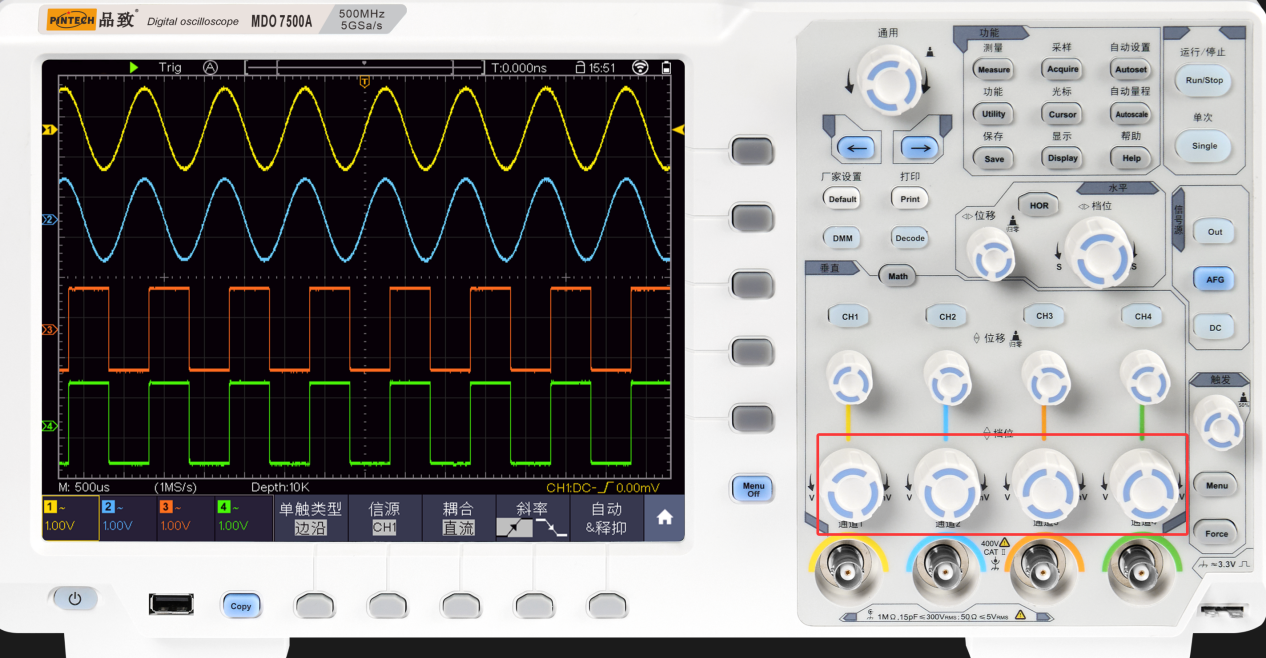
Choosing an appropriate range of measurement can avoid signal distortion and reduce errors. If the range selection is too large, the waveform is too small, and the ADC accuracy of the oscilloscope is not fully utilized, the error will increase; If the range is selected too small, the waveform may easily exceed the screen, resulting in the inability to obtain amplitude and other information. Choose to adjust the vertical range so that the waveform occupies 60% to 80% of the vertical space of the entire oscilloscope screen, making the signal details clearer, thereby reducing errors and improving measurement accuracy. The specific operation is to rotate the vertical range knob to preliminarily adjust the range. If the waveform is not displayed in the center, use the vertical displacement knob to move the waveform to the middle area of the screen, and then fine tune the range again until the waveform is relatively centered and occupies more than 60% of the vertical space, ensuring the effectiveness of signal observation and measurement.
2. Bandwidth limitation
The broadband characteristics of the oscilloscope front-end amplifier and ADC are prone to introducing high-frequency noise, and the measured signal usually has a clear frequency upper limit. In this case, the oscilloscope's bandwidth limiting function can be used to attenuate high-frequency components through a low-pass filter and retain useful signals below the cutoff frequency. The BW Limit function of this model is a single selection of 20MHz. In the corresponding function area of the input channel, press the corresponding button of the channel to find it.
3. Use average sampling mode
Noise is often an irregular random signal. If the measured signal is a periodic signal, the average sampling function of an oscilloscope can be used to make the signal waveform more stable and clear, thereby improving the signal-to-noise ratio. Oscilloscopes perform point-to-point averaging on waveforms captured multiple times. Periodic signals are enhanced due to their correlation, while noise is attenuated due to their randomness. Select the Acquire button - Average function, choose the appropriate number of average calculations from small to large until the waveform becomes clear.
The above methods revolve around the logic of "highlighting useful signals and suppressing noise interference". In practical operation, they can be combined and used based on the frequency characteristics, periodicity, and other specific situations of the measured signal to effectively improve the signal-to-noise ratio.