
Fluxgate Current Sensor

The operating principle of a fluxgate current sensor is based on the characteristics of easily saturated cores (such as iron or nickel alloys, permalloy, etc.). By applying an excitation current to induce alternating saturation in the core, the sensor utilizes the saturation effect of this alternating magnetic field to measure changes in the external current magnetic field.
As shown in the schematic diagram of the fluxgate current sensor below, it uses an oscillator as excitation (typically a square wave) applied to T2 and T2' to cause them to switch between positive and negative saturation. When the current IP flowing through the magnetic core acts on the magnetic field, it causes a change in the magnetic permeability of the T2 and T2' cores. altering the symmetry of the saturation points. This, in turn, affects the magnitude of the current IE flowing through T2 and T2’. Through peak-difference detection, demodulation, and power amplification circuits, the compensation coil NS generates a compensating current IS. This compensating current causes the magnetic flux in the magnetic core to cancel out the magnetic flux generated by the primary current IP. Consequently, the overall bias field of the fluxgate current sensor system is balanced: IP*NP + IS*NS = 0. The sum of the magnetic flux generated by the primary current and that produced by the compensation circuit approaches “zero,” achieving the so-called “zero-flux” state. Consequently, the fluxgate current sensor is also a zero-flux current sensor.
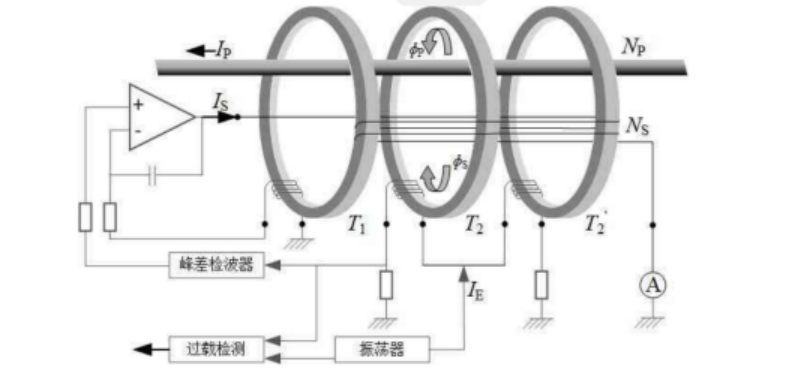
Figure 1: Schematic Diagram of a Fluxgate Current Sensor
What are the advantages of fluxgate current sensors compared to traditional Hall-effect current sensors?
1. Enhanced interference resistance
In terms of magnetic circuit structure, fluxgate sensors do not require an air gap in the magnetic core to accommodate a Hall sensor, unlike Hall-effect current sensors. The sharp drop in magnetic permeability at the air gap in the magnetic core makes it more susceptible to external magnetic fields after the gap is opened. The magnetic circuit of fluxgate-type current sensors is more continuous, making them less prone to interference from external magnetic fields. Consequently, fluxgate current sensors exhibit superior immunity to external interference.
2. Excellent linearity
The magnetic core of the fluxgate remains intact, whereas traditional Hall-effect current sensors exhibit significantly increased hysteresis losses when an air gap is introduced. This occurs because the air gap causes uneven magnetic field distribution, requiring the material to expend more energy during magnetization to overcome the air gap's influence. Due to the hysteresis losses inherent in traditional Hall-effect current sensors, their linearity is relatively poor, making them prone to nonlinear errors when measuring high currents. Therefore, fluxgate current sensors offer greater reliability in applications requiring accurate measurement of high currents.
3. Low temperature drift
Traditional Hall-effect current sensors exhibit relatively poor temperature stability, with temperature variations significantly affecting their measurement accuracy. In contrast, fluxgate current sensors demonstrate superior temperature stability. Therefore, fluxgate current sensors are more suitable for applications involving substantial temperature fluctuations.
4. Low zero drift
The output current of the fluxgate current sensor can be controlled within ±20 μA or even