What is CAT level

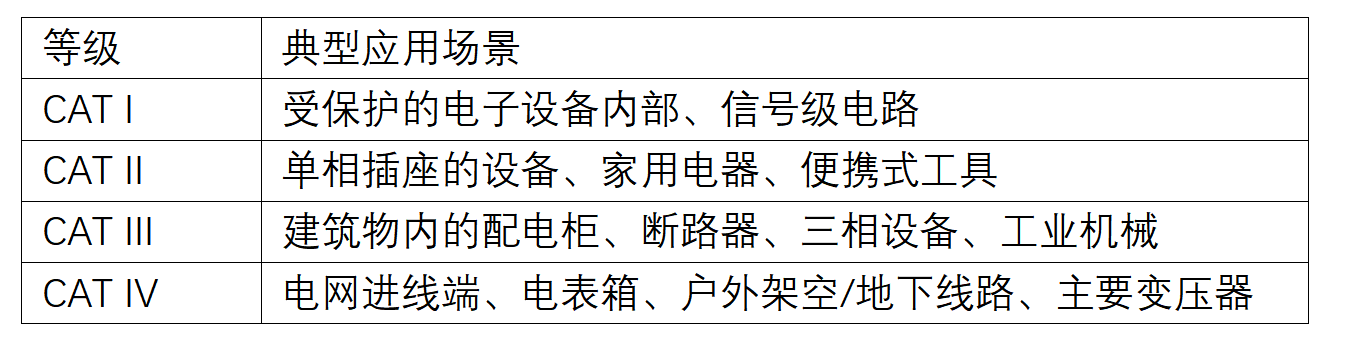
CAT stands for overvoltage category, a classification defined by IEC, used to measure the ability of measuring tools to withstand transient overvoltages (such as lightning strikes, switch surges) in specific electrical environments.
The following table summarizes the four levels of classification, which can help make quick judgments:
Each CAT category also has a withstand voltage rating (pulse test voltage) defined by IEC 61010. These represent surges that devices must safely handle in their environment. The higher the working voltage, the higher the instantaneous peak voltage that can be sustained.
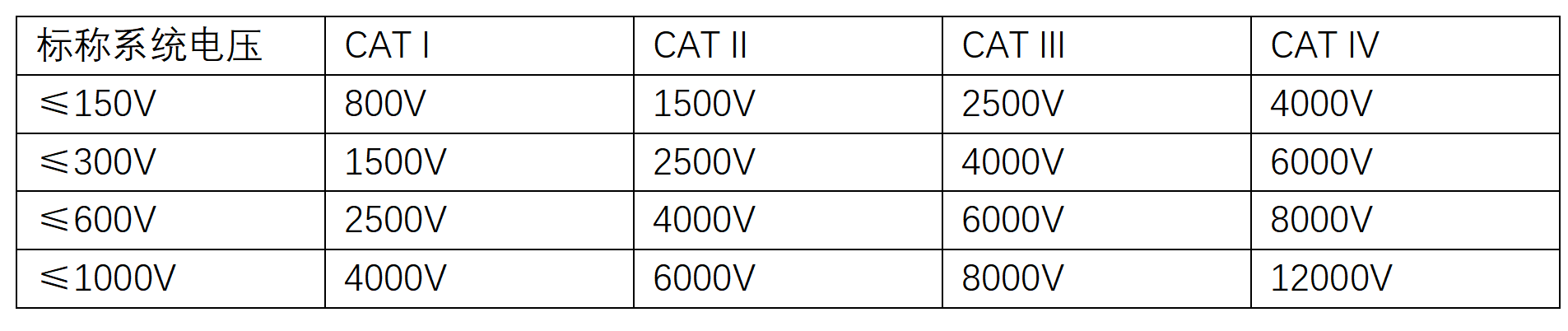
For example, if the multimeter is labeled with "600VCATIII, 1000VCATII", two messages will be obtained:
1. Can be safely used for circuits up to 600V in CATIA II environment.
2. Can be safely used for circuits up to 1000V in CATIA environments.
Analysis
600VCATIII: 600V is a measurable circuit voltage, and the CAT level determines its ability to survive in 6KV transient surges. Similarly, 1000VCATII.
After understanding the level differences, it is more important to know how to ensure safety in practical operations. Here are three core security principles:
1. Prioritize CAT level over voltage values
A 600VCATIII instrument has much higher safety than a 1000VCATII instrument. CATIII instruments must be able to withstand transient pulse tests at 6000V, while CATII instruments can only withstand 4000V at this level.
2. Safety rules
CAT level backward compatibility: High level instruments can be safely used in low-level environments (e.g. CATIA V instruments can be used in CATIA environments).
3. Safety rules
CAT level up incompatibility: This is the most critical safety principle! Under no circumstances should low-level instruments be used in high-level environments. For example, using CATIA instruments to measure CATIA II level distribution cabinets is an extremely dangerous operation!
In short, the CAT safety level of measuring equipment is a comprehensive indicator that depends on multiple factors and is not a fixed value. When selecting a probe, the key is to ensure that its maximum safe voltage and safety level are not lower than the highest possible voltage of the tested circuit and its environment. At the same time, taking safety regulations as the guideline for operation can ensure the safety of personnel and equipment.